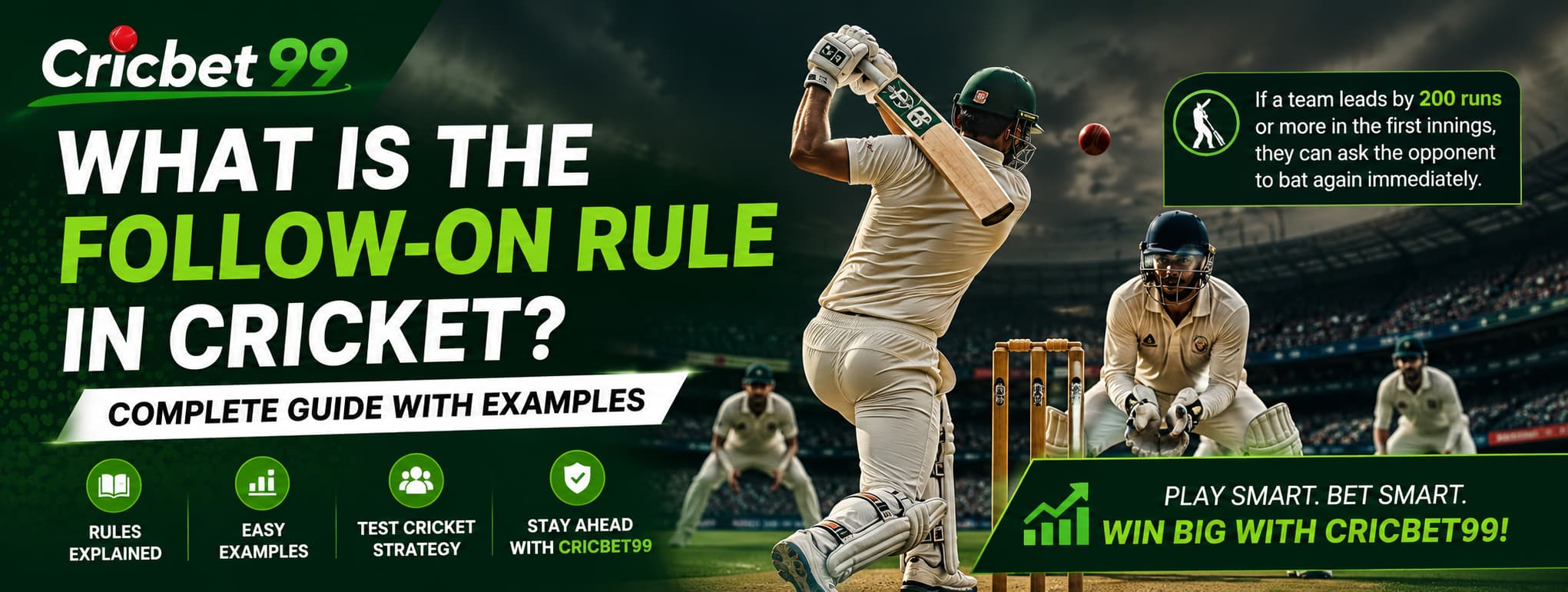
Test cricket is full of tactical decisions that you rarely see in shorter formats such as ODI and T20 cricket. One of the most interesting is the follow-on rule in cricket. If you are new to Test matches, the term can initially sound complicated, but the basic idea is quite simple.
A follow-on can occur when the team batting second finishes its first innings significantly behind the team that batted first. If the required lead has been achieved, the captain of the team that batted first can ask the opposition to bat again immediately, instead of beginning their own second innings.
For cricket followers using Cricbet99, understanding the follow-on rule can make Test matches easier to analyse. It explains why the normal batting order sometimes changes and why a captain may choose to put an opposition team back into bat.
This guide explains what follow-on means in cricket, how many runs are required, how it is calculated, when it can be enforced, and why captains sometimes decide against it.
What Is the Follow-On Rule in Cricket?
The follow-on rule applies to matches in which each side is scheduled to have two innings, most notably Test cricket.
Normally, the innings follow this sequence:
Team A – First innings
Team B – First innings
Team A – Second innings
Team B – Second innings
However, if Team A establishes a sufficiently large first-innings lead, its captain may enforce the follow-on.
The sequence can then become:
Team A – First innings
Team B – First innings
Team B – Second innings (follow-on)
Team A – Second innings, if required
In simple terms, the follow-on gives the team with a substantial first-innings advantage the option to make its opponent bat twice consecutively.
Read More<<<Cricket Match Formats Explained: T20, ODI and Test Cricket
How Many Runs Are Needed for a Follow-On in Test Cricket?
Under Law 14 of the MCC Laws of Cricket, in a match scheduled for five days or more, the team batting first must lead by at least 200 runs after both teams have completed their first innings before it can require the opposition to follow on.
For a standard five-day Test match:
Minimum first-innings lead required = 200 runs
It is important to understand that this refers to the lead, not the opposition’s total score.
Simple Follow-On Example
Suppose India bats first and scores:
India: 500
The opposition then scores:
Opposition: 290
India’s lead is:
500 − 290 = 210 runs
Because the lead is at least 200 runs in a five-day match, India has the option to enforce the follow-on.
The opposition can therefore be asked to begin its second innings immediately.
Access your cricket account securely through the Cricbet99 Login to explore live matches, cricket markets, odds, and account features in one place.
What If the Lead Is Only 199 Runs?
This is where the exact calculation becomes important.
Imagine Team A scores:
450
Team B scores:
251
The first-innings lead is:
450 − 251 = 199 runs
In a five-day match, that would not be enough to enforce the follow-on.
If Team B had instead been dismissed for 250:
450 − 250 = 200
the required 200-run lead would have been reached, giving Team A the option.
Follow-On Requirements for Different Match Lengths
The required lead isn’t always 200 runs. Under the MCC’s follow-on law, the threshold depends on the scheduled duration of the match.
| Scheduled Match Length | Minimum Lead |
|---|---|
| 5 days or more | 200 runs |
| 3 or 4 days | 150 runs |
| 2 days | 100 runs |
| 1 day | 75 runs |
There are additional provisions for matches with no scheduled duration, and playing conditions can matter. For international cricket, followers should therefore also check the applicable competition and ICC playing conditions. A Cricbet99 ID provides registered users with secure account access to cricket matches, betting markets, account management, and other available platform features.
Read More<<<Cricbet99 Official Site – Your Trusted Destination for Cricket Betting and Online Gaming
Who Decides Whether to Enforce the Follow-On?
Reaching the required lead doesn’t automatically trigger the follow-on.
The captain of the team that batted first makes the decision.
Suppose Team A scores 550 and dismisses Team B for 300.
Team A leads by:
250 runs
The captain now has two broad choices:
Option 1: Enforce the follow-on and make Team B bat again.
Option 2: Decline the follow-on and send Team A out to bat for its second innings.
This distinction is important. The rule provides an option, not an automatic requirement.
Why Would a Captain Enforce the Follow-On?
There are several tactical reasons a captain might choose the follow-on.
1. To Push for a Result
Time is extremely important in Test cricket.
If a team has dominated the first two innings but there are only a limited number of sessions remaining, enforcing the follow-on can avoid spending additional time batting.
Instead, the captain can immediately ask the bowlers to attempt to dismiss the opposition again.
2. The Opposition Is Under Pressure
Imagine a team has just been dismissed for 170 after the opposition scored 500.
Making the batting side return immediately can maintain psychological and scoreboard pressure.
Their batters have little time to reset before facing the same bowling attack again.
3. Bowling Conditions Are Favourable
Cloud cover, pitch movement or other favourable bowling conditions may encourage a captain to continue attacking.
If bowlers are consistently troubling the opposition, a captain may decide that this is the best time to make them bat again.
4. Weather Could Reduce Playing Time
Rain and bad light can dramatically affect a Test match.
If significant interruptions are expected, the team in control may want to maximise the number of overs available to dismiss the opposition.
The follow-on can therefore become a tool for time management.
Why Might a Captain NOT Enforce the Follow-On?
A 200-run lead doesn’t necessarily mean enforcing the follow-on is the best tactical choice.
Modern captains frequently consider several other factors.
Bowlers May Need Rest
Suppose the bowling team has just spent 100 overs in the field.
Immediately asking those bowlers to start another innings could create fatigue, particularly for fast bowlers.
Batting again allows the bowling attack to recover.
The Pitch May Become Harder to Bat On
Test pitches can change significantly over several days.
If a captain expects the pitch to deteriorate, batting again can create an enormous target while giving the opposition the difficult task of batting last.
This can be particularly relevant when spin is expected to become more influential later in the match.
Building a Bigger Lead
A captain may simply want to remove as much risk as possible.
For example:
Team A first innings: 500
Team B first innings: 280
Team A leads by 220.
Instead of enforcing the follow-on, Team A could bat again and score another 250 runs.
That would leave Team B facing a theoretical target of:
471 runs
The captain may consider that safer than immediately putting Team B back in. A Cricketbet ID gives registered users access to cricket matches, live odds, betting markets, and account features through a single login.
Can the Follow-On Team Still Win?
Yes.
Enforcing the follow-on does not guarantee victory.
A team that performs poorly in its first innings can produce a much stronger second innings. If it scores enough runs, the team that enforced the follow-on may eventually have to bat again.
There have even been rare Test matches where a team was asked to follow on and subsequently won the match.
This is one reason captains carefully consider match conditions before making the decision.
Follow-On vs Declaration: What’s the Difference?
Beginners sometimes confuse a follow-on with a declaration, but they are completely different Test-cricket india concepts.
A follow-on concerns the batting order after both teams have completed their first innings.
A declaration occurs when the captain of the batting team voluntarily closes their own innings before all ten wickets have fallen.
For example:
India: 520/7 declared
means the captain decided that 520 runs were sufficient and ended the innings despite having three wickets remaining.
Both rules are tactical tools, but they serve different purposes.
Follow-On Calculation Explained
The calculation itself is straightforward:
First team’s score − Second team’s score = First-innings lead
For a five-day Test, if:
Lead ≥ 200 runs → Follow-on can be enforced
If:
Lead < 200 runs → Follow-on cannot be enforced
Example 1
Team A: 475
Team B: 260
Lead:
475 − 260 = 215
Result: Follow-on available.
Example 2
Team A: 410
Team B: 225
Lead:
410 − 225 = 185
Result: Follow-on unavailable in a standard five-day Test.
Example 3
Team A: 600
Team B: 350
Lead:
600 − 350 = 250
Result: Follow-on available.
Cricket 99 provides a convenient platform for cricket fans to explore live matches, cricket odds, gaming markets, and account features in one place.
How Does a Follow-On Affect Test Match Strategy?
The follow-on demonstrates why Test cricket strategy is more complicated than simply scoring the most runs as quickly as possible.
Captains must consider:
- First-innings lead
- Overs remaining
- Number of days remaining
- Weather forecast
- Pitch conditions
- Bowler workload
- Fast-bowler fatigue
- Opposition batting strength
- Wickets taken
- Possibility of a draw
- Fourth-innings conditions
A captain could legally enforce the follow-on but still decide that batting again gives their team a better chance of controlling the match.
Understanding Follow-On Situations on Cricbet99
When following Test cricket through Cricbet99 green, the first-innings scores provide important context for understanding whether a follow-on is possible.
Don’t look only at which team is ahead. Calculate the actual first-innings lead and consider the number of days and sessions remaining.
For example, if the scoreboard shows:
India: 525
Opposition: 310
India’s lead is 215 runs.
In a standard five-day Test, that is enough for the captain to have the option of enforcing the follow-on.
However, knowing that the option exists doesn’t tell you what the captain will actually do. Pitch behaviour, weather, bowling workloads and overall match strategy can all influence the decision.
For users reviewing Test cricket markets on Cricbet99, these factors provide useful match context, but they should never be treated as guarantees of a particular result.
Is There a Follow-On in ODI or T20 Cricket?
No. The traditional follow-on rule does not apply to standard ODI or T20 cricket.
That’s because both are limited-overs formats in which each team normally has one innings.
In a T20:
Team A bats → Team B bats
In an ODI:
Team A bats → Team B bats
The follow-on is associated with two-innings-a-side cricket, especially Test and first-class matches.
This is one of the major differences between T20, ODI and Test cricket.
Read More<<<Cricbet99 Cricket Betting Platform – Popular Brand Among Indian Users
Why Is the Follow-On Important for Cricket Fans?
Understanding the follow-on helps you interpret the strategy behind a Test match.
A scoreboard might show one team leading by more than 200 runs, but that alone doesn’t explain what happens next.
Once you understand the rule, you can start asking more useful questions:
Will the captain enforce the follow-on?
Are the bowlers fresh enough?
Is rain expected?
Will the pitch deteriorate?
Would batting again create a safer fourth-innings situation?
These questions are part of what makes Test cricket tactically fascinating.
Final Thoughts on Follow-on Rule
The follow-on rule in cricket allows a team with a sufficiently large first-innings lead to require its opponent to bat again immediately. In a standard five-day Test match, the relevant threshold is normally a lead of at least 200 runs.
But reaching that threshold doesn’t automatically mean the follow-on will happen. The captain decides whether to enforce it after considering the pitch, weather, available time, bowling workload and overall match situation.
For Cricbet99 India users following Test cricket, understanding concepts such as the follow-on, declaration, innings, first-innings lead, and fourth-innings target can provide much better context for what is happening on the field.
Cricket analysis can help explain a match situation, but it cannot guarantee an outcome, particularly where real-money betting is involved. Get Cricket Bet ID Instantly
Frequently Asked Questions
What is the follow-on rule in cricket?
The follow-on allows the team that batted first to require the opposition to bat again immediately when the required first-innings lead has been achieved in a two-innings match.
How many runs are required for a follow-on in Test cricket?
In a match scheduled for five days or more, the required first-innings lead is at least 200 runs under MCC Law 14.
Is the follow-on compulsory after a 200-run lead?
No. The captain has the option to enforce it. A team can instead choose to bat for its second innings.
Who decides the follow-on?
The captain of the team that batted first decides whether to require the opposition to follow on once the necessary lead has been established.
Can a team win after following on?
Yes. Although uncommon, a team asked to follow on can recover strongly enough to win the match.
Is follow-on available in T20 cricket?
No. Standard T20 cricket has one innings per team, so the follow-on rule doesn’t apply.
Is follow-on available in ODI cricket?
No. An ODI normally gives each team one innings of up to 50 overs, so there is no follow-on.
What is the difference between follow-on and declaration?
A follow-on requires the opposition to bat again after its first innings. A declaration is when a captain voluntarily ends their own team’s innings before all available wickets have fallen.