“Cricbet99 helps me follow cricket markets with a more disciplined approach, focusing on match conditions, team form and smart bankroll management.
I’ve learned that good research supports better decisions from the Cricbet99 team”– Mahesh Sharma,Mumbai
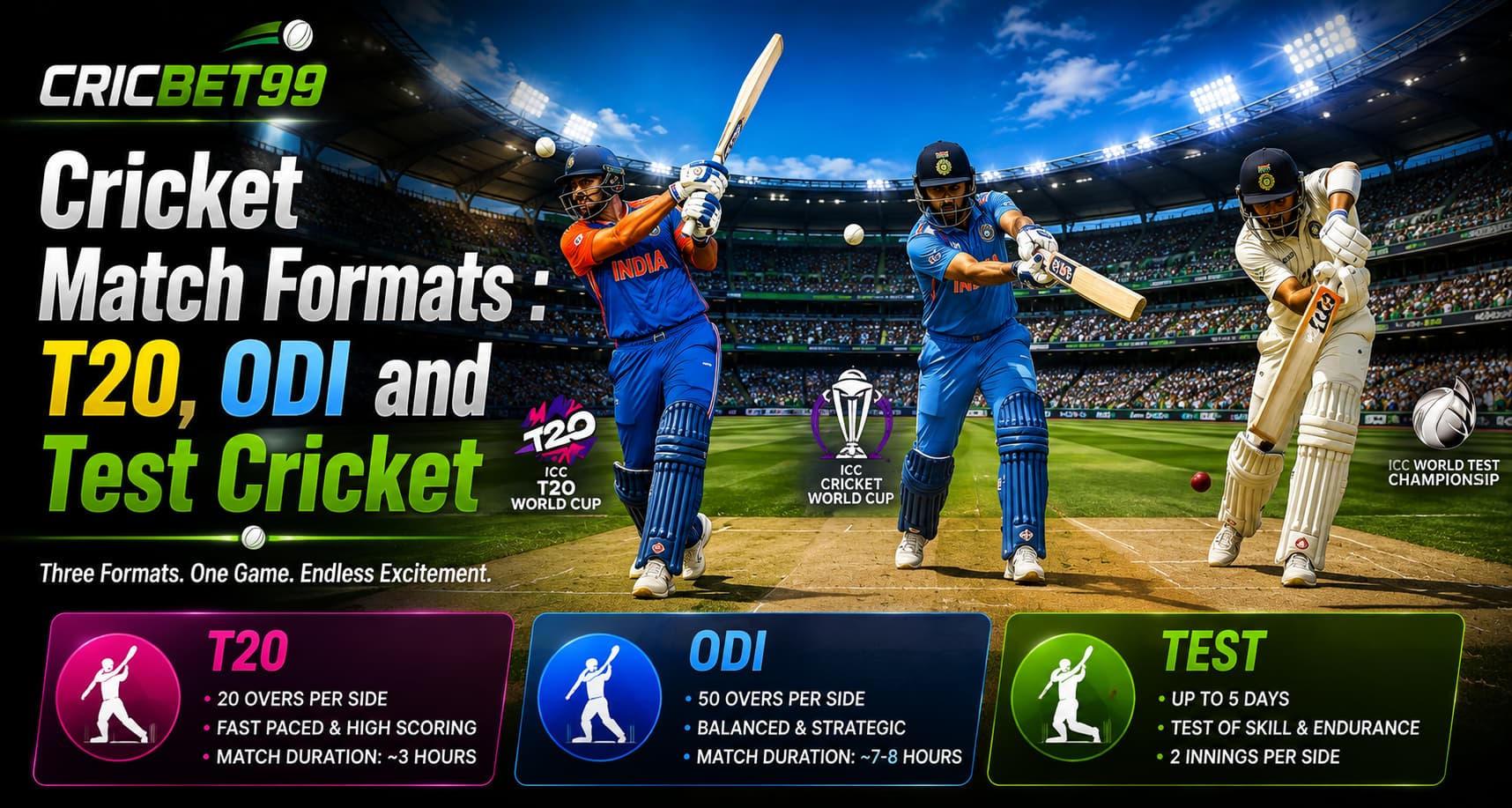
Cricket may be one sport, but not every cricket match is played the same way. A fast-paced T20 match can finish in a few hours, an ODI match usually takes most of a day, while Test cricket can unfold across five days. Each format has its own rules, rhythm, strategies and challenges.
For cricket followers using Cricbet99, understanding these differences can make following a match much easier. Knowing the number of overs, innings structure, powerplay rules and typical match duration gives you valuable context when checking fixtures, scores and cricket markets.
This guide explains the three major cricket match formats — T20, ODI and Test cricket and highlights what makes each one unique.
Read More<<<Beginner’s Guide to Cricket Betting on Cricbet99
What Are the Main Formats of Cricket?
At the international level, cricket is primarily played in three formats:
- Test cricket – the traditional and longest form of the game.
- One Day International (ODI) – limited-overs cricket with 50 overs available to each team.
- Twenty20 International (T20I) – the shortest major international format, with 20 overs available to each team.
The International Cricket Council (ICC) oversees international cricket, while national boards such as the Board of Control for Cricket in India (BCCI) administer cricket within their respective jurisdictions.
Although batting, bowling, fielding, runs and wickets remain fundamental across all three formats, the amount of time available changes how teams approach a match.
T20 Cricket – Fast, Aggressive and Unpredictable
T20 cricket, or Twenty20 cricket, is the shortest of the three major formats.
Each team normally receives a maximum of 20 overs to bat. Because there are only 120 legal deliveries available in an innings, batters generally have less time to settle, and teams often prioritise quick scoring.
A typical T20 match can be completed in approximately three hours, although actual duration varies.
The format has become particularly popular through domestic competitions such as the Indian Premier League (IPL) as well as international T20I matches and the ICC Men’s T20 World Cup.
How Does a T20 Match Work?
A T20 match normally consists of one innings per team.
The first team attempts to score as many runs as possible within 20 overs or before being bowled out. The second team then attempts to chase that total.
For example, if Team A scores:
185/6 in 20 overs
Team B needs 186 runs to win, subject to the applicable playing conditions.
Because there are relatively few overs, individual deliveries can have a noticeable impact on the direction of the match. More detailed information seekers can also browse through match odds through the cricbet99 win login option before a session.
Why Is T20 Cricket So Popular?
T20 has made cricket accessible to viewers who may not have time to follow an entire ODI or five-day Test match.
The format is known for:
- Aggressive batting
- Frequent boundaries
- Powerplay tactics
- Death-over bowling
- Fast changes in momentum
- Strategic bowling changes
- High-pressure run chases
Players may need to make decisions quickly, which is one reason T20 games can remain competitive until the final over. Numerous experienced viewers opt to create an online cricket ID to engage in the match discourse and fantasy leagues.
What Is ODI Cricket?
An ODI, or One Day International, sits between T20 and Test cricket in terms of length.
Each team normally receives a maximum of 50 overs.

That gives batters considerably more time than they have in T20 cricket while still requiring teams to manage a limited number of deliveries.
An ODI generally lasts several hours and is designed to be completed within a single day.
The format is closely associated with major international competitions, particularly the ICC Cricket World Cup.
How Does an ODI Match Work?
Each team normally bats once.
Suppose India scores:
312/7 after 50 overs
The opposition would then need 313 runs to win.
Unlike T20 cricket, where aggressive scoring may begin almost immediately, ODI teams have more opportunity to construct an innings.
A common strategy is to balance:
wicket preservation + strike rotation + boundary scoring + acceleration
Batters might initially focus on building partnerships before increasing the scoring rate later in the innings.
This creates a different tactical challenge from T20 cricket.
What Makes ODI Cricket Different?
ODI cricket rewards teams capable of balancing patience with aggression.
There are enough overs for a team to recover from early wickets, but not enough to bat indefinitely.
For example, a side that loses three wickets early may spend several overs rebuilding its innings before attacking again.
Likewise, bowlers and captains must think carefully about when to use their strongest bowlers.
This makes concepts such as the run rate, required run rate, partnerships, wickets remaining and overs remaining particularly important when following an ODI.
What Is Test Cricket?
Test cricket is the longest-established international format and provides a very different experience from limited-overs cricket.
A Test match can last for up to five days, with each team generally having the opportunity to bat twice.

Unlike T20 and ODI cricket, there is no fixed 20- or 50-over limit for a normal Test innings. Instead, an innings usually continues until the batting team is dismissed, declares its innings, or another applicable playing condition brings it to an end.
This gives Test cricket its distinctive strategic depth.
How Does Test Cricket Work?
A Test match can contain up to four innings:
Team A – First innings
Team B – First innings
Team A – Second innings
Team B – Second innings
However, not every Test reaches all four innings.
Captains must constantly consider the match situation, pitch conditions, weather, remaining time and the number of runs required.
The follow-on and declaration are also important concepts in Test cricket and don’t normally form part of standard ODI or T20 match structures. It is easier to find a sports betting site because you are aware of what analytical information modern broadcasting tools give.
Read More<<<Cricbet99 Cricket Betting Platform
Why Is Test Cricket Considered So Challenging?
Test cricket examines skills that aren’t always as visible in shorter formats.
Batters may need to concentrate for several hours while facing changing pitch and ball conditions. Bowlers may have to construct spells patiently rather than expecting a wicket from every delivery.
Conditions can also evolve throughout a five-day match. Users who want to explore more detailed match information can review available match odds and betting markets through the Cricbet99 Win Login section before starting a session.
A pitch that is comfortable for batting early in the game may behave very differently on the fourth or fifth day.
Test cricket therefore places considerable emphasis on:
- Technique
- Patience
- Concentration
- Bowling endurance
- Defensive batting
- Session management
- Pitch conditions
- Partnerships
- Tactical declarations
The ICC World Test Championship has also provided additional context to bilateral Test series between participating international teams.
T20 vs ODI vs Test Cricket – Key Differences
| Feature | T20 | ODI | Test |
|---|---|---|---|
| Overs per team | 20 | 50 | No standard fixed innings limit |
| Innings per team | 1 | 1 | Up to 2 |
| Typical duration | Around 3 hours | Around one day | Up to 5 days |
| Playing style | Highly aggressive | Balanced | Strategic and patient |
| International designation | T20I | ODI | Test |
| Major ICC competition | T20 World Cup | Cricket World Cup | World Test Championship |
| Draw possible? | Normally no | Normally no | Yes |
This comparison helps explain why the same cricket team may adopt completely different strategies depending on the format.
T20 vs ODI – What’s the Biggest Difference?
The clearest difference between T20 and ODI cricket is the number of overs.
A T20 innings is limited to 20 overs, whereas an ODI innings can last up to 50 overs.
That extra time changes batting strategy considerably.
A T20 batter might attack from the first few deliveries because there is limited time available. In an ODI, a batter can spend longer establishing an innings before accelerating.
Bowling strategies also change because captains have different resources and phases of play to manage.
ODI vs Test Cricket
The biggest difference between ODI and Test cricket is that ODI cricket has a fixed 50-over innings limit, whereas Test cricket allows substantially longer innings and potentially two innings per team.
An ODI must generally produce a result within the limited-overs structure, subject to interruptions and playing conditions.
A Test can end as:
- A win
- A loss
- A draw
- A tie
This possibility of a draw significantly affects Test-match strategy.
A team doesn’t always have to chase victory. Depending on the match situation, survival itself can become the objective.
Understanding Powerplays
The powerplay is an important feature of limited-overs cricket.
Fielding restrictions apply during designated stages of an innings, affecting where fielders can be positioned.
These restrictions influence both batting and bowling strategy.
Batting teams may attempt to take advantage of fielding restrictions by scoring boundaries, while bowling teams look for early wickets that can slow the batting side’s momentum.
Powerplay structures differ between ODI and T20 cricket, so viewers should check the current playing conditions for the competition they are following.
Read This Article: How to Make Consistent Profit in Cricket Betting: Cricbet99 Guide
Understanding Run Rate
Another useful cricket term is run rate.
The current run rate measures approximately how many runs a team is scoring per over.
For example:
100 runs after 10 overs = 10 runs per over
During a chase, you’ll also hear commentators discuss the required run rate.
If a team needs 100 runs from the final 10 overs, the required rate is:
10 runs per over
Required run rate becomes particularly important during ODI and T20 run chases because the batting team has a limited number of overs available.
Read this Guide<<< Cricbet99 Secrets: Features That Make It Popular Among Cricket Fans
Following Different Cricket Formats on Cricbet99
Users following cricket through Cricbet99 may encounter matches from different competitions and formats.
Before following any match or participating in a cricket market, identify whether you’re looking at:
Test → ODI → T20/T20I
Then consider the match situation rather than focusing only on the current score.
For example:
150/3 means very different things depending on whether a team is 150/3 after 15 overs in a T20, 150/3 after 30 overs in an ODI, or 150/3 during the first session of a Test match.
Context matters.
Cricket Terms Beginners Should Understand
If you’re new to cricket, learning a few common terms makes every format easier to follow.
Innings: The period during which a team bats.
Over: A set of six legal deliveries bowled by one bowler.
Wicket: Can refer to the dismissal of a batter or, depending on context, the physical stumps and bails.
Run rate: The average number of runs scored per over.
Powerplay: A period with specific fielding restrictions in limited-overs cricket.
Declaration: A Test-match decision where the batting captain voluntarily ends the team’s innings.
Follow-on: A Test-match rule that can allow the team batting first to require the opposition to bat again immediately when the applicable lead requirement is satisfied.
Understanding the Cricbet99 Glossary of these entities and concepts makes it considerably easier to interpret live scores and match commentary.
Which Cricket Format Is Best?
There isn’t a single objectively “best” cricket format.
It depends on what you enjoy.
If you prefer explosive batting and short matches, T20 cricket may be the most entertaining.
If you like a combination of aggressive cricket and longer-term strategy, ODI cricket provides a middle ground.
And if you appreciate technique, patience and tactical battles developing over several days, Test cricket offers something the shorter formats cannot reproduce.
Many cricket fans enjoy all three for completely different reasons.
Final Thoughts on Cricket Format
Understanding the differences between T20, ODI and Test cricket makes it much easier to appreciate how teams and players adapt to different situations.
T20 cricket emphasises speed and immediate decision-making. ODI cricket requires teams to balance aggression with innings management across 50 overs. Test cricket adds another level of patience, endurance and long-term strategy.
Whether you’re following the IPL, an ICC T20 World Cup, the Cricket World Cup, the World Test Championship, or another international series, understanding the format gives every score, wicket and partnership more context.
For Cricbet99 users following cricket fixtures and markets, always check the match format and current playing conditions first. And where real-money gaming is involved, remember that cricket outcomes are uncertain—statistics and analysis can provide context, but they cannot guarantee a result. Get Cricket ID instantly
FAQs on Cricket Format
What are the three main formats of international cricket?
The three major international cricket formats are Test cricket, One Day Internationals (ODIs), and Twenty20 Internationals (T20Is).
How many overs are there in T20 cricket?
Each team normally has a maximum of 20 overs in a T20 innings.
How many overs are played in ODI cricket?
Each team normally receives a maximum of 50 overs in an ODI innings.
How many overs are there in Test cricket?
A normal Test innings doesn’t have a fixed 20- or 50-over limit. Test matches can last for up to five days, subject to the applicable playing conditions.
How long does a T20 cricket match last?
A T20 match typically takes around three hours, although the exact duration can vary.
What does ODI mean in cricket?
ODI stands for One Day International, a limited-overs international cricket format in which each team normally receives up to 50 overs.
What is T20I?
T20I stands for Twenty20 International, an international T20 match played between eligible national teams.
Which cricket format is played in the IPL?
The Indian Premier League (IPL) uses the T20 format, with each team normally receiving a maximum of 20 overs per innings.
Read More Cricbet99 Blogs
- Cricbet99 PhonePe & GPay Payment Support: Failed, Pending and Missing Transactions
- Cricbet99 Account Statement: How to Understand Your Transaction Records
- Cricbet99 Login on a New Device: Security Checks Explained
- Cricbet99 Dashboard Explained: Account Settings and Available Features
- Cricbet99 APK Latest Version Download 2026: Complete Android Guide